Every wastewater treatment plant produces something besides treated water. At the bottom of settling tanks and inside biological treatment systems, a thick mixture of water and solids gradually collects. That material is called sludge, and managing it can be one of the more demanding parts of running a treatment facility. Ion Exchange addresses this challenge through wastewater and sludge treatment solutions that help industries and municipalities manage residual waste, reduce handling difficulties and explore recovery opportunities where feasible.
It is easy to focus on the quality of treated water and overlook what has been removed from it. But those contaminants have not disappeared. Much of the suspended matter and biological solids end up in sludge, which must be managed properly before disposal or any beneficial use.
What Is Sludge in Wastewater Treatment?
The semi-solid waste is known as sludge, which is a residue form of water after physical, chemical, or biological treatment has been completed. The treated sludge has high water content along with organic matter, microorganisms, suspended materials, and any other materials that have been eliminated in the process.
The components of sludge vary according to the source of the wastewater.
Thus sewage sludge may include organic matter, biomass, and nutrients. On the other hand, industrial sludge may vary greatly, especially if it has heavy metals, oil, or any chemical contaminants.
Sludge also differs in its consistency. It may be thin slurry like or in the form of a thick cake.
Where Does Sludge Come From?
A typical waste sewage treatment facility separates pollutants during various phases of the process.
In the primary stage of treatment, solids fall to the bottom of clarifier tanks where they are collected. The mass of solids obtained by the process is called primary sludge.
In biological treatment, microbes help get rid of biological pollutants present in sewage. As the population of micro-organisms grows, there comes a need to dispose of some part of biomass to keep optimum conditions for the treatment process. The end product of the biological step is termed secondary sludge.
Chemical treatment may also produce some residual solids due to the reaction between coagulants and other chemicals used for treatment with some contaminants present in the effluent.
Thus, when a facility processes industrial wastewater, different types of sludge will be produced which may have different composition and characteristics.
Before choosing the equipment for treatment facilities, operators must have an understanding of the composition of the sludge produced and the quantity of it.
Why Is Sludge Treatment Necessary?
Untreated sludge is difficult to store, transport and dispose of. Much of its weight comes from water, while the organic material can decompose and generate unpleasant odours.
Depending on its source, it may also contain pathogens or hazardous substances.
The importance of sludge treatment becomes apparent when storage tanks fill faster than expected or disposal vehicles are needed more frequently.
Removing excess water reduces the volume requiring handling. Stabilisation can help control biodegradable organic matter and odour. Additional processing may be needed to reduce pathogens or prepare the material for a permitted end use.
Without proper management, sludge can create secondary pollution risks even when the main wastewater treatment plant is performing well.
How Does the Sludge Treatment Process Work?
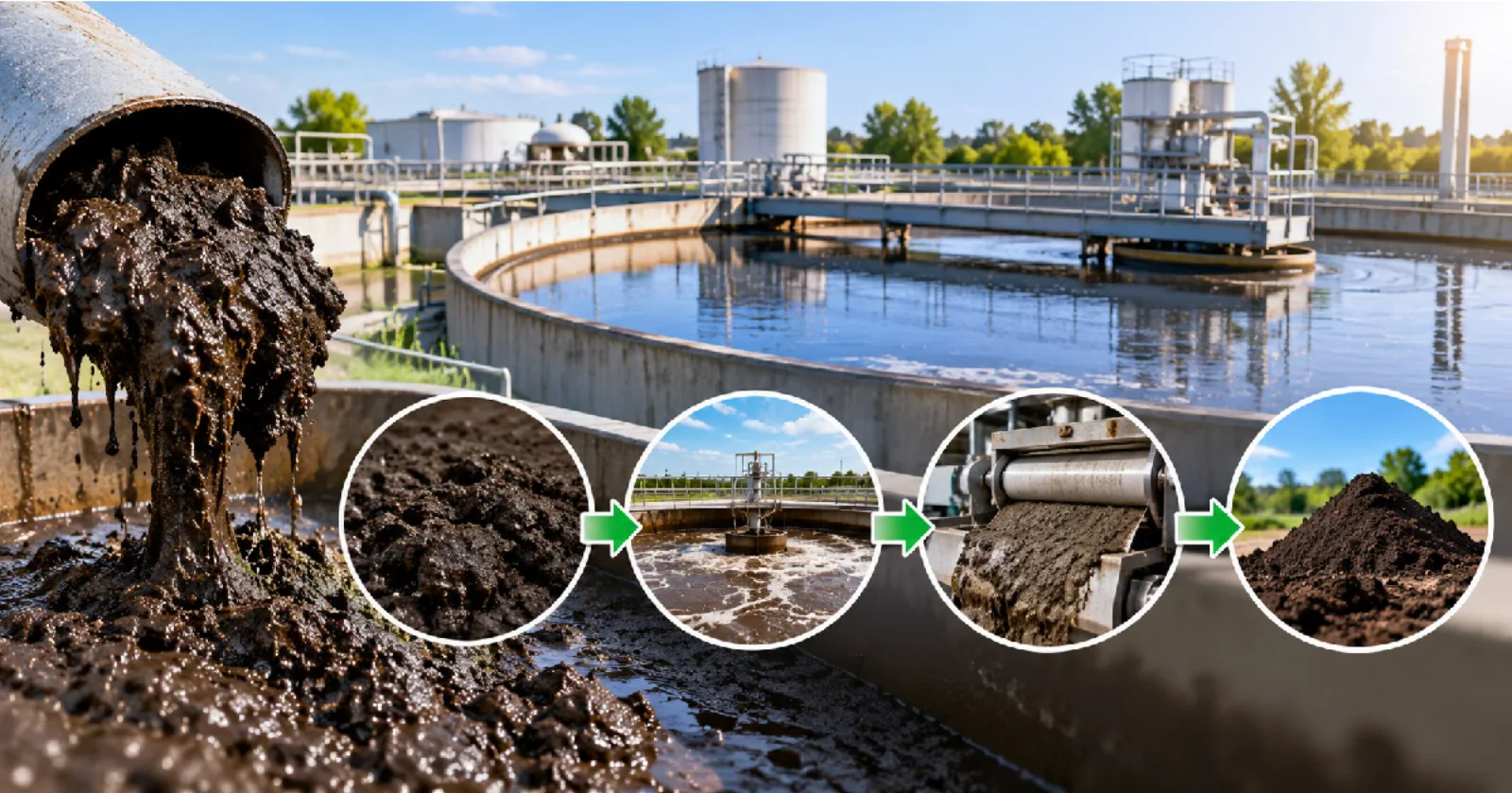
The sludge treatment process usually involves several steps, although their order and selection depend on sludge characteristics and the intended disposal route.
1. Sludge Thickening
Fresh sludge often contains very little solid material.
Thickening removes part of the water so that subsequent processes handle a smaller volume. Gravity thickeners, dissolved air flotation and mechanical thickening equipment may be used.
The result is still a pumpable material, but with a higher solids concentration.
This step can reduce the size and operating requirements of downstream equipment.
2. Sludge Stabilisation
Thickening does not necessarily make sludge biologically stable.
Organic matter may continue decomposing, causing odour and handling problems.
Stabilisation helps reduce these issues. Aerobic and anaerobic digestion are common approaches, while alkaline or thermal processes may be appropriate for particular applications.
The objective is to make the material more stable and suitable for subsequent handling.
3. Conditioning and Dewatering
Removing more water from sludge is not always straightforward. Fine particles can hold moisture, making mechanical separation difficult.
Conditioning chemicals, commonly polymers, may be added to improve how the particles aggregate and release water.
The conditioned sludge then passes through equipment such as a filter press, centrifuge or belt press.
This stage produces a dewatered cake that is generally easier to transport than liquid sludge.
4. Drying and Final Management
Some facilities need additional moisture removal before disposal or further processing.
Drying beds, solar drying or thermal drying may be considered, depending on available space, climate, energy costs and sludge characteristics.
The final material must then be managed according to its composition and applicable regulations.
Common Sludge Treatment Methods
Different sludge treatment methods serve different purposes. Some primarily reduce moisture, while others improve biological stability or allow resource recovery.
Aerobic Digestion
Aerobic digestion uses microorganisms operating in the presence of oxygen to break down biodegradable organic matter.
It can be suitable for certain sewage treatment applications, particularly where plant scale and operating conditions support it.
However, aeration consumes electricity, which influences operating expenses.
Anaerobic Digestion
Anaerobic digestion takes place without oxygen.
Microorganisms break down organic material and produce biogas containing methane and carbon dioxide. The biogas may be collected and used for energy after appropriate treatment.
This makes anaerobic digestion particularly interesting for facilities handling suitable organic-rich sludge.
Mechanical Dewatering
Filter presses, centrifuges and belt filter presses remove moisture mechanically.
The right equipment depends on sludge quantity, solids characteristics, polymer requirements and the desired cake dryness.
For an industrial facility, the difference between transporting liquid sludge and dewatered cake can be substantial.
Composting and Thermal Treatment
Composting may be suitable for appropriately treated organic sludge that meets the necessary safety and quality requirements.
Thermal drying and other thermal processes can further reduce moisture or prepare residual material for specific handling routes.
Not every sludge stream is suitable for agricultural use. Chemical composition, contaminant levels and regulatory permissions must be assessed first.
How to Choose the Right Treatment Method
A common mistake is selecting dewatering equipment based only on daily sludge volume.
Two plants generating the same amount of sludge may need different equipment because their solids behave differently.
Biological sludge often responds differently to conditioning than chemically generated sludge. Particle size, organic content and moisture retention can all influence dewatering efficiency.
Operating costs deserve attention too.
A filter press may offer suitable cake dryness but require a particular maintenance and operating arrangement. A centrifuge may provide continuous operation but has its own energy and service requirements.
The best choice comes from analysing sludge characteristics, running suitable trials where necessary and considering the final disposal method.
Sludge Management and Resource Recovery
Sludge is usually discussed as a disposal problem, but some streams offer recovery opportunities.
Organic-rich sludge may support biogas generation through anaerobic digestion. Treated biosolids may also have beneficial applications where their composition, treatment and regulatory status permit.
However, the presence of organic matter does not automatically make sludge suitable for reuse.
Industrial residues containing hazardous contaminants require particular care.
The importance of sludge treatment extends beyond reducing volume. Proper characterisation can help facilities identify which materials require controlled disposal and which may have potential for safe recovery.
How Ion Exchange Supports Sludge Management
Ion Exchange offers holistic solutions for treating both water as well as wastewater.
The company's activities include the development of biological wastewater treatment technology, sludge disposal technology, as well as waste-to-energy technology.
INDION® waste-to-energy technology introduced by company combines co-digestion of organic wastes and sewage sludge, which leads to the generation of biogas and disposal of treated solids.
In the case of industrial wastewater treatment plants, the processing of waste can be organized in such a way that the focus will be made on thickening and dewatering the sludge before its disposal.
This broad perspective of treatment provides the ability to take sludge treatment into consideration at the design stage, instead of covering it later at an additional cost.
Thus one can say that the design of a wastewater treatment plant is not accomplished until the processing route for produced solids is developed.
Sludge Management Is Part of Effective Wastewater Treatment
Removing contaminants from wastewater is only one part of the job. The resulting sludge must also be handled safely and economically.
A properly designed sludge treatment arrangement can reduce moisture, improve stability, simplify handling and support appropriate disposal or recovery.
For plant operators, the starting point is understanding the sludge itself. Its composition, daily quantity, dewatering behaviour and final destination should guide technology selection.
Planning a new wastewater treatment facility or facing sludge-handling challenges at an existing plant? Connect with Ion Exchange to explore integrated treatment and sludge-management solutions suited to your operating requirements.
Frequently Asked Questions
1. What is sludge treatment in wastewater management?
Sludge treatment involves processes that reduce the water content, biodegradable organic matter and other risks associated with sludge. It prepares the material for safer handling, further processing or appropriate disposal.
2. What are the main sludge treatment methods?
Common methods include thickening, aerobic digestion, anaerobic digestion, chemical conditioning, mechanical dewatering, composting and drying. The selection depends on sludge characteristics and the intended end use.
3. What is the difference between sewage sludge and industrial sludge?
Sewage sludge comes from municipal wastewater treatment and commonly contains organic matter and microbial biomass. Industrial sludge may contain additional process chemicals, metals or other contaminants depending on the industry.
4. Why is the sludge treatment process important?
It reduces the volume of material requiring handling, helps control odour and biological instability, and supports safer disposal. Some treatment routes can also enable resource recovery.
5. Can treated sludge be reused?
Some appropriately treated sludge can be used beneficially, including in permitted land applications or energy-recovery processes. Suitability depends on contaminant levels, treatment quality and applicable regulations.