

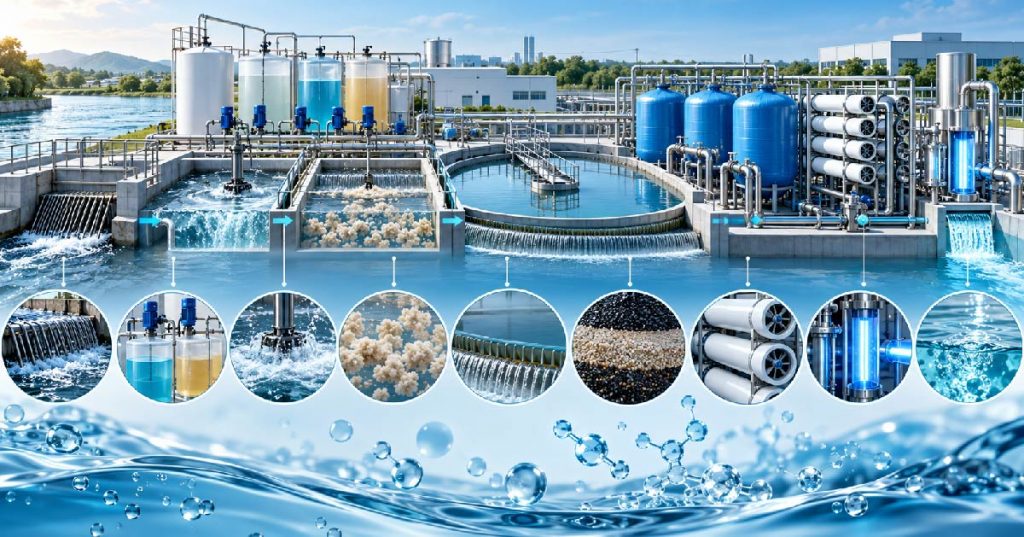
Water treatment is often explained as a sequence of equipment: clarifiers, filters, softeners, membranes and disinfection systems. That is only half the picture. Behind many of those stages is a carefully controlled chemical programme doing work that the equipment cannot accomplish on its own.
Changes in the raw water quality might make themselves evident quite quickly. For example, turbidity increases after the rains, scale develops in a cooling tower, and an RO system blocks more rapidly than expected. Therefore, the choice of treatment chemicals does not only become an issue of purchase.
The key issue is that there is no universal approach to the application of chemicals at different stages of treatment.
What Are Water Treatment Chemicals Used For?
Water treatment chemicals are added to water or wastewater to change conditions that would otherwise interfere with treatment, equipment or final water quality.
Depending on the circumstances, it may aid in destabilizing particles in suspension, regulating pH, hardness and preventing scaling, among other processes: limiting corrosion, inhibiting growth of microorganisms and disinfecting treated water. For this reason, it is inappropriate to talk about water treatment chemicals as a homogenous group of substances. A coagulant that is introduced before clarification has a very different task than a scale inhibitor that is added prior to the reverse osmosis membrane.
At best, the chemical process is integrated with the process of treatment rather than working independently of it.
Stage 1: Coagulation and Flocculation
Fine suspended and colloidal particles do not always settle naturally. They can remain dispersed in water for long periods because of their small size and surface charge.
Coagulation tackles this problem first. Chemicals such as aluminium- or iron-based coagulants can destabilise these particles, allowing them to come together.
Flocculation follows. Here, polymeric coagulants and flocculants help the destabilised particles form larger, stronger flocs that can be separated during clarification or sedimentation.
Ion Exchange Kenya also identifies coagulation and flocculation as an important stage for removing fine suspended matter before downstream treatment.
Dose is critical. More chemical does not automatically mean better clarification. Water chemistry, turbidity, pH and mixing conditions all influence the result.
Stage 2: pH and Alkalinity Adjustment
Many water treatment reactions work properly only within a certain pH range.
Thus, it is possible to adjust the water pH, so acids or alkalis can be used. Some chemicals may include caustic alkaline agents or lime, and selected types of acids, depending on the aim of the treatment.
While not very visible, pH correction is one of the important processes that may substantially affect plant performance. If the pH level is incorrect, the coagulant may not perform well, metals may not precipitate, and other downstream processes might become unstable.
Thus, pH correction must ensure the appropriate water tests and procedure.
Stage 3: Clarification and Solids Separation
While clarification relies primarily on physical sedimentation, it is chemistry that governs how well that sedimentation will work.
This is where the initial choice of coagulants and flocculating agents can come into play. It is much easier to remove quality, stable flocs such as those obtained through the process of flocculation. Weak flocs are more prone to disintegration and thus can cause turbidity to flow into the following filtration phase.
Water treatment plants with variable inlet water must adjust the chemical doses used in treatment as the quality of the raw water changes.
It is important to make such adjustments, as poor clarification will not only lead to the poor appearance of water. It will also increase the amount of particles present at the output of the process.
Stage 4: Filtration and Pretreatment
Conventional filters do not always require continuous chemical addition at the filter itself, but upstream water treatment process chemicals strongly influence how long a filter performs before cleaning or backwashing becomes necessary.
Specialty chemistry may also be used where iron, manganese, organics or specific contaminants have to be controlled.
For membrane pretreatment, the requirements become more demanding. Feed water needs to be conditioned carefully because deposits that appear manageable in conventional systems can cause serious problems on a membrane surface.
Stage 5: Scale and Corrosion Control
Industrial plants often use water in boilers, cooling circuits and heat-transfer systems. Here, the concern moves beyond simply removing contaminants from incoming water.
Minerals can concentrate and form scale. Dissolved gases and salts can contribute to corrosion. Microbiological activity can create deposits and reduce heat-transfer efficiency.
Industrial water treatment chemicals used in these systems may include scale inhibitors, corrosion-control formulations and other conditioning chemicals selected for the operating environment.
Ion Exchange’s INDION Specialty Water Treatment Programme includes dedicated chemical treatment for cooling water and boiler water alongside other industrial applications.
This is an area where looking only at chemical price can become expensive. A treatment programme should ultimately protect equipment performance, not simply reduce the amount spent on chemicals.
Stage 6: Membrane Protection
Reverse osmosis and other membrane processes have changed industrial water treatment, but membranes are sensitive to feed-water conditions.
As dissolved salts become concentrated, sparingly soluble compounds can precipitate and form scale on the membrane. Antiscalants are used to reduce this risk.
Membrane-cleaning chemicals serve a different purpose. They are used when deposited material needs to be removed during planned cleaning.
These water treatment chemicals should not be considered substitutes for good pretreatment. If solids, hardness or biological loading reach the membrane uncontrolled, chemical cleaning alone will not solve the underlying problem.
Ion Exchange includes both antiscalants and membrane-cleaning products within its specialty chemical portfolio.
Stage 7: Disinfection and Microbial Control
Once suspended and dissolved contaminants have been addressed, microbial control becomes another important treatment barrier.
Chlorine-based chemistry remains widely used because it can inactivate microorganisms while also providing residual protection in distribution systems. Ion Exchange Kenya identifies chlorination as an established disinfection approach, while also noting the growing use of controlled dosing and monitoring.
The dose has to be controlled carefully. Insufficient disinfectant may compromise microbial control, while unnecessary overdosing can create taste, corrosion or by-product concerns depending on water chemistry.
For industrial systems such as cooling towers, biocide programmes may also be needed to manage biological growth.
How to Select the Right Water Treatment Chemical Types
A useful chemical programme starts with analysis, not a product list.
There are various factors that contributes to selecting the chemical for water treatment like the quality of source water, its intended use, temperature, flow rate, pH, hardness, levels of suspended solids, the level of microbial activity and the equipment downstream.
Evaluating the water treatment chemicals as part of entire system is very important. The fact that it is a successful change in one stage does not mean there would be no issues in other stages.
As an example, good coagulation will help get rid of water, but it would make sludge volume go higher. An anti-scalant could be the right product but its effect on the membranes is still very unpleasant, due to poor pretreatment.
How Ion Exchange Supports Industrial Chemical Treatment
Ion Exchange Kenya provides water treatment, wastewater treatment, resins, consumables and specialty chemical programmes for industries across Kenya and East Africa. Its INDION range includes cooling- and boiler-water treatment chemicals, coagulants and flocculants, antiscalants, membrane-cleaning chemicals and testing solutions.
When using the integrated approach, one benefits from the fact that one cannot separate the two concepts from each another.
The recurring scale problem, for example, could lead one to review the antiscalant. The problem could also be connected with the variability of feed water, incorrect softening, recovery settings or the effectiveness of the pretreatment.
Due to this integrated approach Ion Exchange can look at the chemistry in connection with the treatment process and not treat chemical dosing as a separate process.
Final Thoughts
The role of water treatment chemicals changes from one stage to the next. Coagulants help prepare fine particles for removal. Flocculants strengthen solids separation. pH-adjustment chemicals create the right reaction conditions. Antiscalants protect membranes, while utility-treatment chemicals help manage scale, corrosion and biological growth.
The most effective programme is rarely the one using the most chemistry. It is the one using the right chemistry, at the right point, for a clearly understood reason.
If chemical consumption is increasing, equipment is scaling, membranes are fouling more frequently or treatment performance has become inconsistent, connect with Ion Exchange experts to review the complete water treatment programme and identify the most appropriate treatment strategy.
FAQs
What are the most common chemicals used in water treatment?
Common categories include coagulants, flocculants, pH-adjustment chemicals, disinfectants, scale inhibitors, corrosion-control chemicals, antiscalants and membrane-cleaning formulations. The actual selection depends on water quality and treatment objectives.
What are the main water treatment chemical types?
They can broadly be grouped by function: clarification chemicals, pH-control chemicals, disinfection chemicals, boiler and cooling-water chemicals, membrane-treatment chemicals and specialty process chemicals.
Why are coagulants and flocculants used together?
Coagulants destabilise very fine suspended particles, while flocculants help those particles combine into larger flocs that are easier to settle or filter.
Which industrial water treatment chemicals are used for RO systems?
RO plants may use antiscalants to limit mineral scaling and specialist cleaning chemicals during membrane cleaning. Pretreatment chemistry may also be needed depending on feed-water quality.
How should a plant choose water treatment process chemicals?
Selection should be based on water analysis, treatment objectives, operating conditions, downstream equipment and testing. Chemical dose and product choice should be reviewed whenever influent characteristics or plant conditions change.